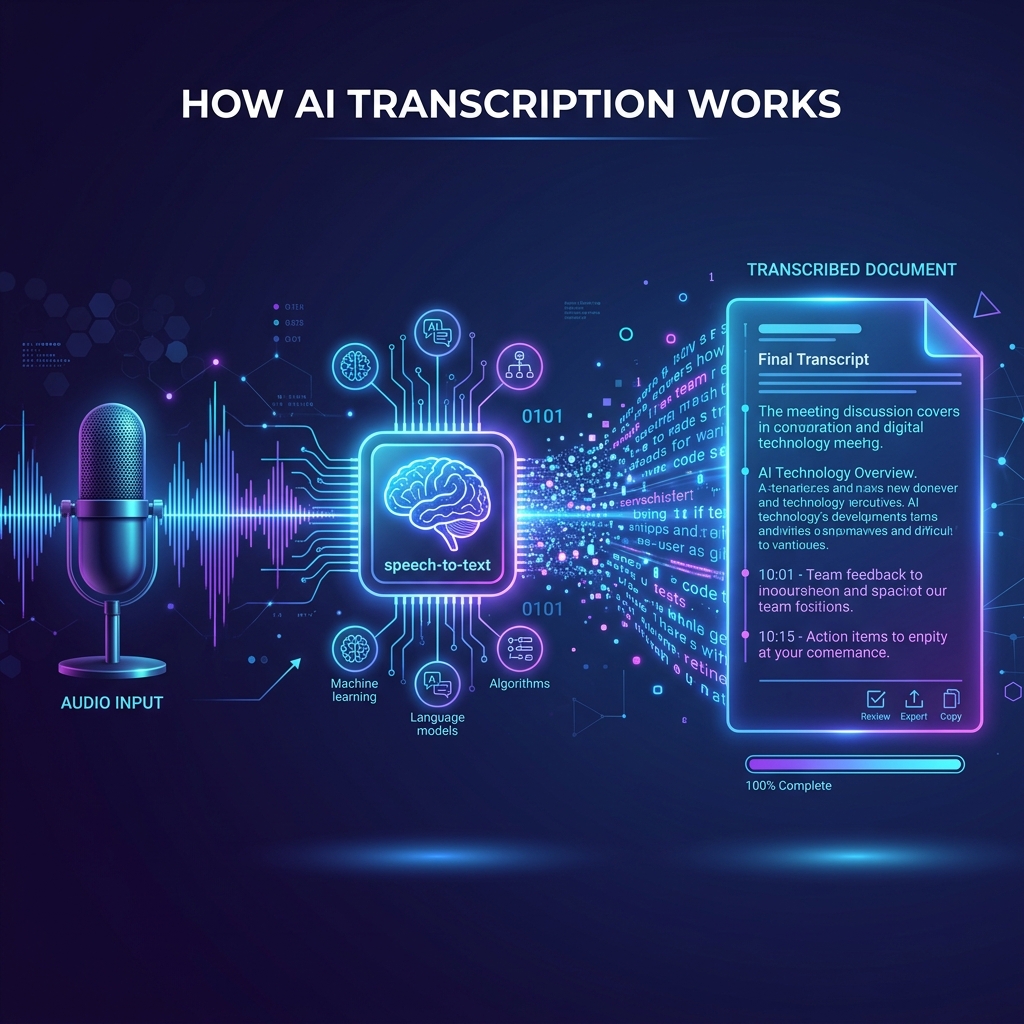
Modern Automatic Speech Recognition (ASR) has shifted from classical Hidden Markov Models (HMM) to end-to-end deep learning architectures. This guide breaks down the data flow, acoustic feature extraction, and sequence-to-sequence decoding that answers exactly how AI transcription works in production.
1. The Audio Processing Pipeline
Before neural networks can interpret speech, raw audio waves must be transformed into a format suitable for spatial and temporal pattern recognition.
Signal Ingestion and Pre-Processing
Audio is ingested, resampled (typically to 16kHz), and converted to a mono channel. The signal is then framed into overlapping windows (e.g., 25ms windows with a 10ms shift) to capture the time-varying nature of speech.
Mel-Spectrogram Extraction
The core of modern ASR feature extraction relies on mapping audio frequencies to human auditory perception scales.
| Pipeline Stage | Transformation | Output Shape (Approx) | Purpose |
|---|---|---|---|
| STFT | Short-Time Fourier Transform | (N_frames, Frequency_bins) | Converts time-domain to frequency-domain |
| Mel Filterbank | Mel-Scale Mapping | (N_frames, 80) | Maps frequencies to human hearing ranges |
| Log-Scaling | Logarithmic Compression | (N_frames, 80) | Compresses dynamic range for stable gradients |
This output matrix, the log-Mel spectrogram, is the actual input tensor fed into the neural network.
2. Transformer-Based ASR Architecture (Whisper Model)
Systems like OpenAI's Whisper utilize a standard Encoder-Decoder Transformer architecture.
The Encoder: Acoustic Representation
The encoder ingests the (N_frames, 80) spectrogram tensor. It typically employs two 1D Convolutional layers to sub-sample the sequence and capture local temporal relationships.
The output is processed through a stack of Transformer Encoder blocks (Self-Attention + Feed-Forward Networks). Each block computes a contextualized representation of the audio frame, allowing the model to understand acoustic features in the context of the entire utterance.
The Decoder: Sequence Generation
The decoder autoregressively predicts the text sequence, token by token. It relies on two attention mechanisms:
- Masked Self-Attention: Attends to previously generated text tokens.
- Cross-Attention: Attends to the encoder's acoustic representations, aligning text generation with specific audio frames.
3. Optimizing Inference: Faster Whisper
Deploying standard transformer models for real-time transcription introduces significant latency and memory overhead. Faster Whisper is a reimplementation in C++ (using CTranslate2) designed for high-efficiency inference.
Key Optimization Techniques
| Technique | Mechanism | Impact on Inference |
|---|---|---|
| Weight Quantization | Reduces weights from FP32 or FP16 down to INT8 | 4x reduction in memory footprint, faster compute |
| Graph Optimization | Operator fusion and constant folding via CTranslate2 | Reduces kernel launch overhead on GPU/CPU |
| Batch Decoding | Groups short utterances into a single batched tensor | Maximizes GPU utilization and throughput |
| VAD Integration | Voice Activity Detection (Silero VAD) filters out silence | Prevents hallucinations and saves compute cycles |
By combining these optimizations, platforms that utilize AI meeting assistants operate the Whisper Tiny model efficiently on constrained edge or serverless environments without encountering Out-of-Memory (OOM) errors.
4. Architectural Implementation in MeetMind AI
Our backend orchestrates transcription using FastAPI. The architecture prioritizes low memory overhead and rapid context switching, forming the foundation of how MeetMind AI works.
# Simplified ASR Pipeline Implementation
from faster_whisper import WhisperModel
import logging

class ASRPipeline:
    def __init__(self, model_size="tiny", device="cpu", compute_type="int8"):
        # Load quantified model into memory once
        self.model = WhisperModel(model_size, device=device, compute_type=compute_type)
        logging.info(f"Loaded {model_size} model on {device} with {compute_type} precision.")

    def transcribe(self, audio_path: str):
        # Transcribe with VAD filtering to drop silent segments
        segments, info = self.model.transcribe(
            audio_path,
            beam_size=5,
            vad_filter=True,
            vad_parameters=dict(min_silence_duration_ms=500)
        )

        # Generator yields segments for streaming responses
        return [segment.text for segment in segments]
Strategic Trade-offs
- Model Size vs Accuracy: We use the
tinyorbasemodels for near real-time latency, trading off the marginal accuracy gains of thelargemodels which require 10GB+ VRAM. - Stateless Execution: Transcription tasks are stateless. To keep the database footprint minimal, individual
Segmentsare omitted from historical API queries unless specifically requested by the client.
Conclusion
Understanding how AI transcription works helps you appreciate the deep learning innovations making meetings more productive. If you want to put this technology into practice without the complex setup, try MeetMind AI today to automatically transcribe and summarize your meetings!