Table of Contents
In the early evolution of AI meeting assistants, generating a passive summary of a one-hour call represented a significant breakthrough in workplace productivity. You could skip a meeting, read the generated executive summary, glance at the action items, and move on.
However, as organizations scale their reliance on AI-generated documentation, passive summaries reveal their limitations. Users increasingly want to query their meeting data interactively. While standard LLMs (Large Language Models) excel at generating conversational responses, using a generic chat interface on top of a raw transcript introduces severe reliability risks—most notably, hallucinations.
The solution emerging in 2026 is the context-aware meeting chatbot, which relies on a hybrid architectural approach combining structured metadata, deterministic routing, and semantic LLM reasoning.
The Architectural Flaws of Generic AI Summarizers
Most early-generation meeting AI tools rely entirely on LLM summarization. Sending an entire transcript through a neural network for every query creates several engineering bottlenecks:
- Hallucinated Identities: If a user asks a pure LLM, "How many people spoke in this meeting?" the model often guesses by counting the names mentioned in the transcript text. It cannot natively distinguish between an active participant and a colleague mentioned in passing.
- Context and Grounding Loss: Passive summaries aggregate details. If a user queries exactly why an engineering decision was made, an LLM relying solely on an aggregated summary lacks the necessary context to provide a verifiable answer.
- Redundant Compute Costs: Sending repetitive queries for structured data (like "What are the action items?") through a 70-billion parameter model is computationally inefficient and introduces unnecessary latency.
How Context-Aware Meeting Chatbots Work
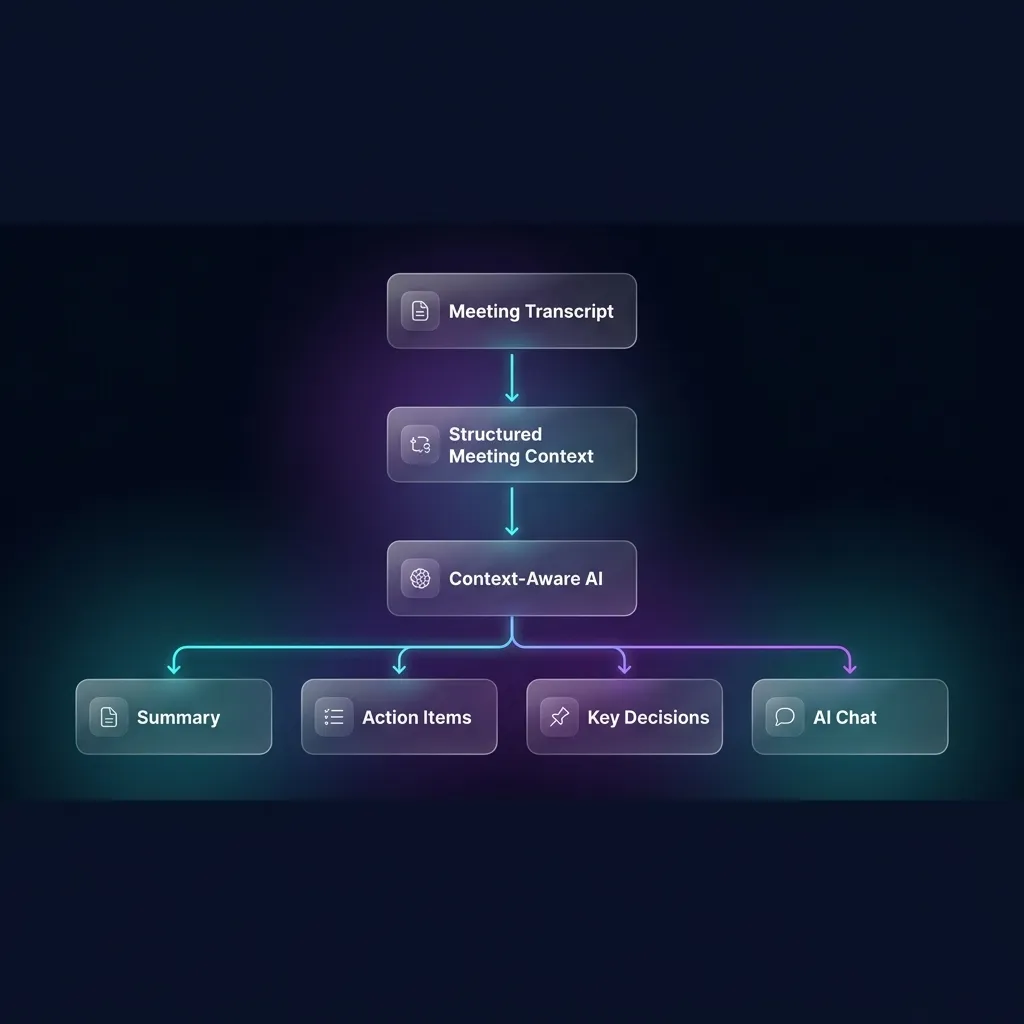
A context-aware meeting assistant does not treat a meeting simply as a large string of text. Instead, it treats the meeting as a structured database object. The architecture involves several distinct layers: speaker diarization, timestamp extraction, deterministic routing, and bounded conversation memory.
1. Hybrid Routing: Deterministic vs. Semantic
The core of a reliable meeting chatbot is knowing when not to use an LLM. By implementing hybrid routing, the system can classify a user's intent and route it to the appropriate data layer.
Deterministic Retrieval (Structured Data): For straightforward, factual queries, the system uses deterministic routing to fetch pre-processed structured JSON data. This approach significantly reduces the risk of hallucinations.
- Example Query: "What are the action items?"
- System Action: Bypasses the LLM entirely. The backend retrieves the
action_itemsarray generated immediately after the meeting and renders it directly.
Semantic Retrieval (LLM Reasoning): For complex, nuanced questions, the system routes the query to the LLM, but injects the raw transcript context and structured metadata into the prompt.
- Example Query: "Why did the team decide to delay the launch?"
- System Action: The LLM analyzes the transcript context to synthesize a logical explanation based on the participants' actual debate.
2. Speaker Diarization
Understanding who said what is a fundamental challenge in audio processing. Context-aware bots utilize speaker diarization—the process of partitioning an audio stream into distinct segments mapped to unique speaker IDs (e.g., Speaker 1, Speaker 2).
When you ask a context-aware chatbot, "How many speakers were detected?", the system calculates the number of unique speaker IDs present in the audio metadata. It does not ask the LLM to guess. Furthermore, these speaker IDs are prefixed to the transcript text (e.g., [Speaker 1]: Let's approve the budget.) before it is sent to the LLM. This provides the AI with the structural context necessary to correctly attribute statements, a practice increasingly adopted in conversational AI to improve grounding and reduce attribution errors.
3. Strict Timestamp Grounding
Verifiability is crucial for enterprise software. If an AI claims that a specific architectural decision was finalized, users must be able to audit that claim against the source audio.
Context-aware chatbots utilize timestamp grounding. The backend dynamically formats the transcript payload to include verifiable timestamps (e.g., [Speaker 2] [14:32]: We should use PostgreSQL.). The system prompt strictly instructs the LLM to cite these provided timestamps when answering semantic questions. Crucially, the model is restricted from generating its own timestamps, ensuring that any citation provided actually exists in the source data.
4. Bounded Conversation Memory
A truly intelligent assistant maintains conversation context. If a user asks, "What were the key decisions?" and follows up with "Why did they make the second one?", the chatbot must understand the semantic link.
By securely bounding the chat history—typically limiting context to the most recent 6 to 10 exchanges—the system can maintain continuous dialogue without overflowing the model's context window or causing context degradation. This ensures follow-up questions are answered accurately based on the ongoing exchange.
Where Context-Aware Meeting Chatbots Can Still Fail
While hybrid architectures and structured metadata significantly improve reliability over generic summarizers, context-aware systems are not flawless. It is important to understand their technical limitations:
- Transcription and Diarization Errors: If the underlying Speech-to-Text (STT) model mishears a word or incorrectly merges overlapping speakers, the chatbot will inherit that flawed data. Diarization struggles heavily in environments with high background noise or rapid cross-talk.
- Ambiguous References: If participants use heavy jargon or ambiguous pronouns (e.g., "Let's go with that idea"), the LLM may struggle to resolve the context accurately, even with perfect transcription.
- Missing Meeting Context: The chatbot only knows what was explicitly spoken. It cannot factor in pre-meeting emails, shared documents not read aloud, or non-verbal visual cues (like a nod of agreement).
- LLM Hallucinations: While deterministic routing handles factual data, complex semantic questions routed to the LLM still carry a non-zero risk of hallucination. Edge cases in prompting can occasionally cause the model to infer incorrect motivations.
- Human Verification Required: Because of these inherent risks, AI outputs should be treated as highly capable drafts. Critical business, legal, or medical decisions must always be verified by a human against the source audio or transcript.
The Shift Toward Interactive Knowledge
The transition from passive, auto-generated documents to interactive, context-aware architecture represents a fundamental maturation in how we handle meeting data. By effectively combining the creative reasoning of LLMs with the rigid accuracy of deterministic routing, modern systems offer a substantially more reliable way to extract knowledge from conversations.
As you evaluate tools for your own team, look beyond the basic summary interface and consider how the underlying architecture handles structured data, speaker context, and verifiability.
If you are interested in testing a hybrid deterministic and semantic meeting assistant, explore how MeetMind AI handles intelligent meeting workflows.
Ready to eliminate manual meeting notes?
Secure your meeting data while generating accurate AI summaries in minutes.
- AI Meeting Notes & Summaries
- Automated Action Item Tracking
- Search Across Every Meeting